Institute TV.
The Institute's research and teaching, narrated: a broadcast layer over everything that already runs on this site. Thirty-six episodes, rendered on-device by our own pipeline and published free. Every film points back at something you can open, drive, or read.
 ▶
▶▶ Channel trailer · one minute of what the Institute already runs
Start here
What the Institute is, in a minute, and why it's your tomorrow.
 ▶
▶Why Physical AI, and why it's your tomorrow
Yesterday intelligence lived behind glass; today it steps into the world; tomorrow it gets rebuilt, and the door…
 ▶
▶The Institute for Physical AI: channel trailer
One minute of what the Institute already runs: live robot sims, courses you drive, and the Atlas of the field ,…
Teaching shorts
A single concept from the courses, made concrete in a few minutes.
 ▶
▶How a robot learns to walk: reinforcement learning, explained
You don't program every joint. You reward the robot for moving forward and staying up, and it discovers the how ,…
 ▶
▶Teach a robot with words: Vision-Language-Action (VLA), explained
Say “pick up the red block” and the robot sees the scene, matches your words to the object, and turns it into…
Read the paper · transcript & deep-dive ↗ ▶
▶Show it, don't program it: imitation learning, explained
The fastest way to teach a robot a skill often isn't code or reward, it's demonstration. Show it a few times and…
 ▶
▶How a robot sees: perception and occupancy, explained
A robot can't act on a flat photo. It rebuilds the scene as a model of space: what's free to move through, what's…
 ▶
▶Let the compiler catch it first: Rust's borrow checker for robots
In Rust the borrow checker refuses to compile code that misuses ownership, the bug is caught at your desk, before…
Course companions
A full lesson, watched end to end.
 ▶
▶A full Rust lesson, start to finish, ownership & the borrow checker
A whole lesson end-to-end: open the real bench, hit the borrow-checker error, read it, fix it, and watch the rover…
Inside the labs
Every research topic, told as a short film, the same work that ships as a white paper you can run.
 ▶
▶Can you trust a swarm?, deterministic autonomy
143 drones, one WGSL solver, stepping bit-for-bit identically on any GPU. Reproducible autonomy you can verify,…
 ▶
▶Why plugging things in is hard: compliant manipulation
Command an exact position and it jams; command force and the part slides down the chamfer and seats itself.…
 ▶
▶A world model that predicts: Spatial AI
The world held as a living field of Gaussian splats that forecasts where it will be, a moment ahead. See it and…
Read the paper · transcript & deep-dive ↗ ▶
▶How a robot feels: vision-based touch
A fingertip that sees touch: a soft skin over a camera. From how light and shadow shift, it reconstructs the shape…
Read the paper · transcript & deep-dive ↗ ▶
▶One world, many eyes: OmniSense
Every camera and viewpoint fused into one shared, resolved volume of space. Where one sensor is blind, another…
Read the paper · transcript & deep-dive ↗ ▶
▶Proving a robot won't fall: the Lyapunov certificate
Don't just test a controller: prove it. Interval branch-and-bound certifies stability across the whole region. A…
Read the paper · transcript & deep-dive ↗ ▶
▶Print the muscles too: the printed body
Every joint is one axial-flux actuator, re-sliced per joint. Nine of ten subsystems already print; only the drive…
Read the paper · transcript & deep-dive ↗ ▶
▶What if AI stopped multiplying?, ternary compute
Multiplication is where most of the energy goes. Ternary math replaces it with something a chip can almost do for…
Read the paper · transcript & deep-dive ↗ ▶
▶Why a hand doesn't drop things: grasp stability
You squeeze just enough. Sense the start of a slip and tighten only as much as you must. Force closure, from touch.
 ▶
▶A sensing fabric you can't spoof: Spatial RF
Fuse six radio bands, each weighted by how hard it is to fake. A real event corroborates across all of them; a…
Read the paper · transcript & deep-dive ↗ ▶
▶The bottleneck is people: the Diffusion Layer
The skill to design silicon spreads like any technology, slowest for the deep, tacit expertise. Model the levers…
Read the paper · transcript & deep-dive ↗ ▶
▶The reproducibility you can afford: energy-native compute
Push a computer to use less energy and it gets noisy, and noisy means you can't reproduce the answer. There's a…
Read the paper · transcript & deep-dive ↗ ▶
▶One fluid, three currents: microfluidic co-optimization
Power, heat, and compute usually mean three systems. What if one fluid network carried charge, heat, and…
Read the paper · transcript & deep-dive ↗ ▶
▶Sampling is the compute: thermodynamic Physical AI
Some of the hardest AI problems are about probability, sampling. Nature already samples, for free, through heat.…
Read the paper · transcript & deep-dive ↗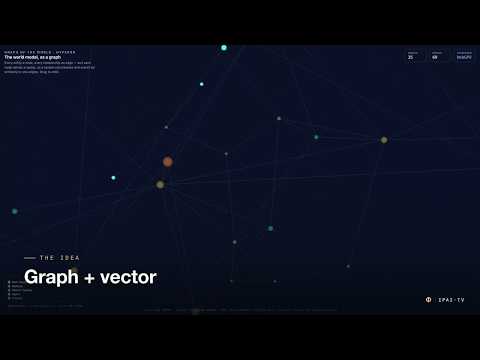 ▶
▶The world, as a graph: hyperdb
Every entity a node, every relationship an edge, and each node carries a vector. One engine that follows the links…
Read the paper · transcript & deep-dive ↗ ▶
▶Air-traffic control for a thousand drones: volume operations
A live operations twin of a city's low-altitude airspace: real corridors, live multi-band traffic, and strategic…
Read the paper · transcript & deep-dive ↗ ▶
▶A skin that pays twice: persistent aerial platforms
A high-altitude aircraft that never lands: its metasurface skin harvests energy AND shapes its radar signature.…
Read the paper · transcript & deep-dive ↗ ▶
▶Every way to compute: the Compute Atlas
47 methods across 9 families, dated from 1925 to now, optical, neuromorphic, thermodynamic, quantum. Not moats;…
Read the paper · transcript & deep-dive ↗ ▶
▶Leave the disk and it rings: why a robot's touch is a Smith chart
A wave meets a boundary and whatever doesn't match comes back. The condition for a robot to touch an unknown world safely is the geometry Phillip Smith drew in 1939…
Read the paper · transcript & deep-dive ↗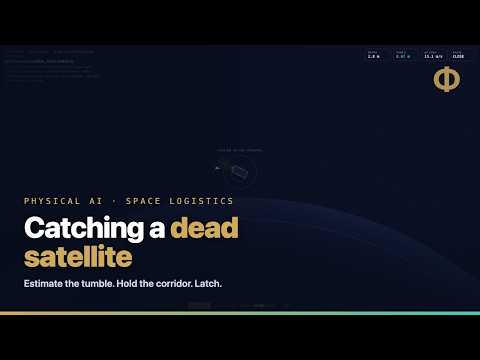 ▶
▶Catching a dead satellite: Physical AI for space logistics
Moving mass through space is a velocity budget. The modes that pay it down, a momentum-exchange tether catch, a…
Read the paper · transcript & deep-dive ↗Shorts
One idea, one breath. Vertical, fast, made to share.
 ▶
▶Can you trust a swarm? #Shorts
A hundred drones, as one. Run it twice, same result? Bit-for-bit, on any GPU.
 ▶
▶Print a robot's muscles? #Shorts
3D-print a robot's body, sure. But its motors? Nine of ten parts already print.
 ▶
▶Prove a robot won't fall #Shorts
Don't test it: prove it. Green means mathematically certified.
 ▶
▶How a robot learns to walk #Shorts
You don't program it. You reward it, and it figures out the rest.
 ▶
▶Teach a robot with words #Shorts
Tell it, in plain words. It sees, and it acts. Vision-Language-Action.
 ▶
▶Show it, don't program it #Shorts
Teach a robot a new skill by showing it, and it learns to copy you.
 ▶
▶How a robot sees #Shorts
Not a photo: a model of space it can move through. That's perception.
 ▶
▶The compiler catches it first #Shorts
A bug in robot code, caught before the robot ever moves. Rust's borrow checker.
 ▶
▶Leave the disk and it rings #Shorts
A robot is safe touching an unknown world only while its impedance stays inside the unit disk. Cross the line and the contact chatters.
 ▶
▶Catching a tumbling satellite #Shorts
A dead satellite won't hold still. The chaser estimates its tumble, holds a certified corridor, and latches, on…
Watch, subscribe, share.
New films land as the research and courses grow. Everything is free.
Open the channel on YouTube ↗Read the research it's built on →